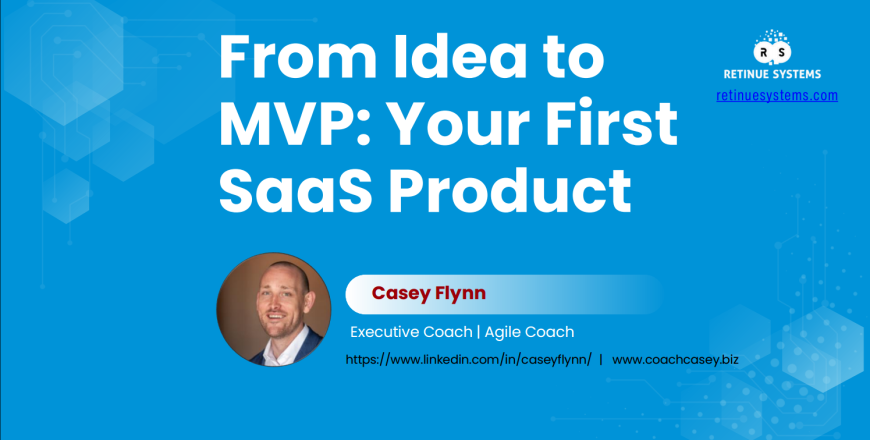

This course is taught by Casey Flynn a a Senior Agile coach at Thomson Reuters helping B2B SaaS teams build generative AI solutions. Here is what Casey covers in this course:
In this course, Casey guides you through the essential steps of taking your SaaS idea from concept to Minimum Viable Product (MVP) including a vibe coding demo using Lovable. We’ll explore how to validate your idea, understand your competition, define your core value proposition, and choose the right tech stack, all while emphasizing the importance of starting small and moving quickly.
He shares his personal experiences, including lessons learned from failures, to help you avoid common pitfalls. He encourages you to actively engage with your target customers and gather feedback to refine your product. If you want deeper guidance, feel free to connect with me through Retinue Systems or LinkedIn.
-
1
 Intro and Topic Overview
This is the intro for the course and an overview of the topics.
-
2
What's the need?
Learn how to uncover a real, painful customer problem and validate that a true market exists before you build anything.
-
3
Formulating Founding Hypothesis
Learn to express your idea as a testable hypothesis and use fast, low-risk experiments—like design sprints—to validate the path to product-market fit.
-
4
Conducting Competitive Analysis
Learn how to assess direct and indirect competitors, understand user behavior, and identify the real alternatives you must outperform to drive adoption.
-
5
Core Value Proposition
Learn to define the one or two differentiators you can be the best at and articulate why customers will choose your solution over every other option.
-
6
Building for Different Stages
Learn which tools and approaches to use at each stage—from earliest testable product to earliest lovable product—so you ship quickly without overbuilding.
-
7
Demo: Vibe Coding with Lovable
Learn how AI-powered prototyping and vibe-coding tools let you build quick, cheap testable versions of your idea to get early product-market-fit signals.
-
8
Improving Through Feedback Loops
Learn how to tighten your learning cycles by testing with innovators and early adopters and using their observations—not opinions—to iterate effectively.
-
9
Wrap Up
Review the essential principles for validating your idea, differentiating effectively, building smart at each stage, and rapidly moving toward product-market fit.
-
10
 Course Materials

 Google