
POC vs Prototype vs MVP: What they really mean and when to use each
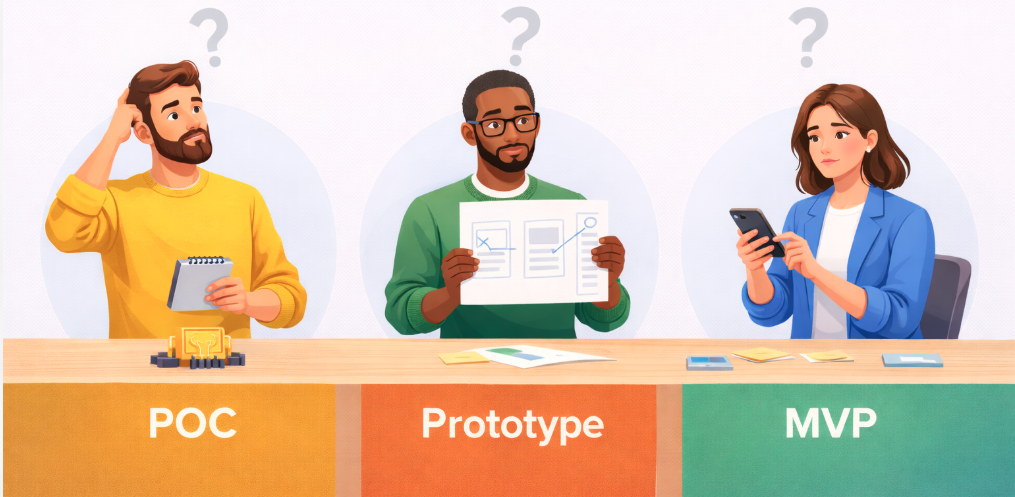
In product and startup conversations, POC, Prototype, and MVP get thrown around a lot. Sometimes they are used interchangeably, sometimes incorrectly, and often without a shared understanding across product, engineering, and leadership. The result is teams building the wrong thing at the wrong time, burning runway, and confusing progress with impact.
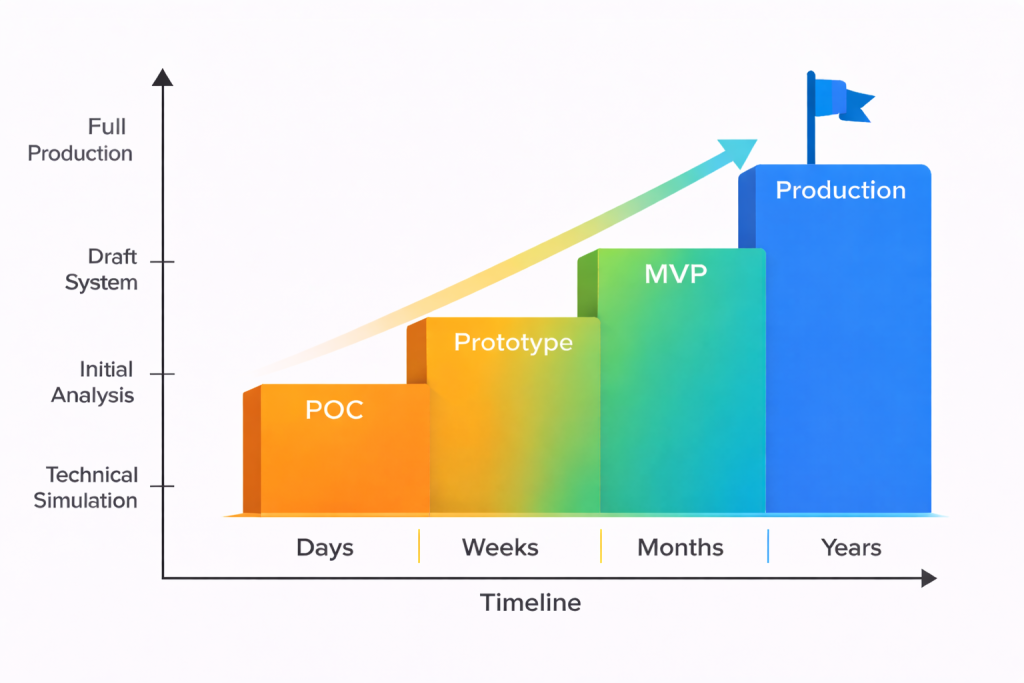
At a high level, these three stages answer very different questions. A POC asks can we build it? A Prototype asks how should we build it? An MVP asks will anyone actually use or pay for this? Understanding those distinctions and respecting them is one of the most important skills a product team can develop.
Proof of Concept (POC): reducing risk
A Proof of Concept exists to validate feasibility. It is not about users, polish, or scalability. It is about proving that a risky or uncertain technical idea works well enough to justify further investment. POCs are usually small, fast, and intentionally limited in scope.
For example, imagine a team exploring an AI-powered feature that automatically summarizes long documents. Before worrying about UI or workflows, the real question is whether an AI model can produce summaries that are accurate, fast enough, and cost-effective. A POC might be nothing more than a script or API endpoint that sends sample documents to a model and prints the results.
This is where cloud platforms like Amazon Web Services, Google Cloud Platform, or Microsoft Azure shine. You can spin up a small function, call an AI service, test performance, and shut it down without committing to long-term infrastructure. Data storage is often minimal. If anything is persisted at all, it might be a simple MySQL table or even temporary in-memory storage. Redis may show up briefly for quick caching or throttling, but nothing here is meant to last.
A successful POC ends with confidence. Either the idea is technically viable, or it is not. Both outcomes are valuable.
Prototype: shaping the solution
Once feasibility is proven, the next challenge is figuring out how the product should actually work. This is where prototypes come in. A prototype focuses on user experience, system design, and architectural direction. It helps teams explore options, compare approaches, and gather early feedback without committing to full production standards.
In the AI summarization example, a prototype might introduce a basic web interface. Users upload a document, click a button, and see a summary. Multiple prompt strategies might be tested. Feedback might be collected on tone, length, and usefulness. The goal is not perfection. The goal is learning.
Cloud architecture becomes more intentional at this stage. You may start using managed services, a basic API layer, and a real database. MySQL often becomes the system of record for users and documents, while Redis is introduced for caching summaries, managing sessions, or protecting downstream AI calls. The system still is not designed for scale, but it is starting to resemble something real.
Prototypes are especially useful for alignment. They help product managers communicate intent, developers explore tradeoffs, and founders show progress to stakeholders or investors.
MVP: validating the market
An MVP is where many teams stumble. An MVP is not just a better prototype. It is the smallest product that delivers real value to real users in a real environment. Its purpose is to validate demand, not to showcase technical sophistication.
By the time you reach an MVP, core assumptions should already be validated. The AI works. The user flow makes sense. Now the question is whether anyone cares enough to use it consistently or pay for it. This is where production concerns matter. Authentication, monitoring, error handling, cost controls, and data integrity can no longer be ignored.
At this stage, cloud choices have long-term consequences. Whether running on AWS, GCP, or Azure, teams need to think about scaling, observability, and security. MySQL is no longer optional or experimental. It is a critical dependency. Redis often becomes essential for performance, caching AI results, and protecting APIs from spikes in traffic.
A successful MVP gives clarity. Strong usage signals mean it is time to scale. Weak signals mean it is time to iterate or pivot. Either way, decisions are now driven by real data, not assumptions.
Why the distinction matters
The biggest mistake teams make is skipping stages. Building an MVP when a POC would have sufficed leads to wasted effort. Polishing a prototype instead of validating demand delays learning. Treating AI experiments like production systems too early introduces unnecessary complexity and cost.
Each stage exists to reduce a specific type of risk. POCs reduce technical risk. Prototypes reduce product risk. MVPs reduce market risk. When teams respect those boundaries, they move faster with less friction.
Final thoughts
Modern AI tools and cloud platforms have dramatically lowered the cost of experimentation. That is a gift, but it can also be a trap. Speed without clarity leads to noise. Progress without purpose leads to burnout.

If there is one takeaway, it is this: always be explicit about which question you are answering. Are you proving feasibility, shaping the solution, or testing the market? When everyone on the team can answer that clearly then you know if you should build a POC, Prototype, or MVP. And these stop being buzzwords and start becoming powerful tools for building the right thing at the right time.
At Retinue Systems we can partner with you at any stage in building your product. Contact us here today to discuss partnering.
 Google